
Issue 12: Clean Energy Acceleration “May Mean Peak Fossil by 2030”
Welcome to the 12th Cleaning Up Newsletter of 2026.


Michael Liebreich completed a packed programme of speeches, presentations and private meetings in Australia and New Zealand during late May and early June, meticulously organised by Jo Jagger, and assisted by Cleaning Up’s head of operations, Kendall Smith.
During one of the most demanding trips he has undertaken in the last 25 years, Michael took the pulse of the energy transition in a region with its own challenges and opportunities while also delivering an upbeat view on the impetus the Iran Crisis has given to electrification, and decarbonisation.
Among the messages he got from policy-makers, investors, industry executives and NGOs was that there has been huge progress in Australia on solar roofs, and domestic and big-scale batteries, but much less on electric vehicles and the switch away from diesel, and on wind transmission.
Michael found a “high-quality climate community with robust commitment to climate action and clean energy” but he also encountered political toxicity (as in Europe and the US) and some residual, unrealistic thinking on the potential for hydrogen.
News from Cleaning Up
The Cleaning Up tour Down Under is about to bear fruit, in the shape of Cleaning Up’s first miniseries, Deep Dive Australia, a special nine-episode run of interviews to be published on Mondays from 29 June onward. This miniseries will include Michael’s chats with federal and state ministers, renowned economists and infrastructure leaders.
Michael spoke at Australia’s National Press Club on 2 June, arguing – in relation to the Middle East crisis – that “whatever the question, clean energy can offer, if not the whole answer, at least a very substantial part of it”. He said that the “Great Clean Energy Acceleration 2.0” he expects to result from the Hormuz Crisis could well mean that we see “peak fossil fuels and peak emissions this side of 2030”.
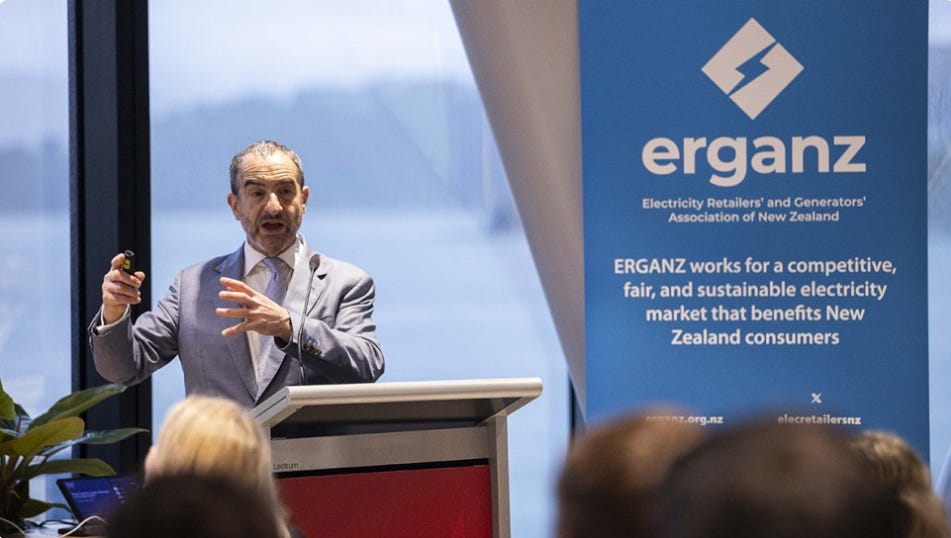
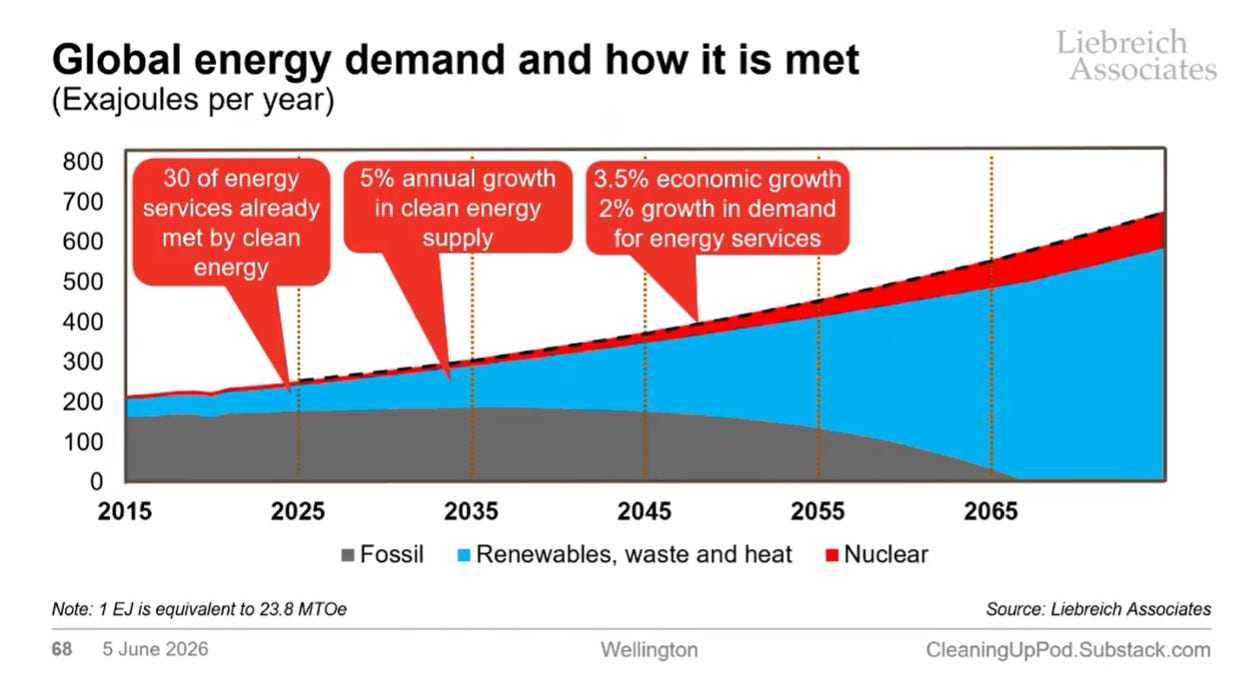
From Australia, Michael moved on to New Zealand, where on 5 June he gave an address at an event hosted by the Electricity Retailers and Generators Association, known as erganz for short. He described the world as now “almost in the middle third” of the transition to clean energy (see photo and slide below). Michael said he tentatively backed the NZ government’s decision to approve investment in a liquified natural gas import terminal, because he was “a bit of a resilience hawk”.
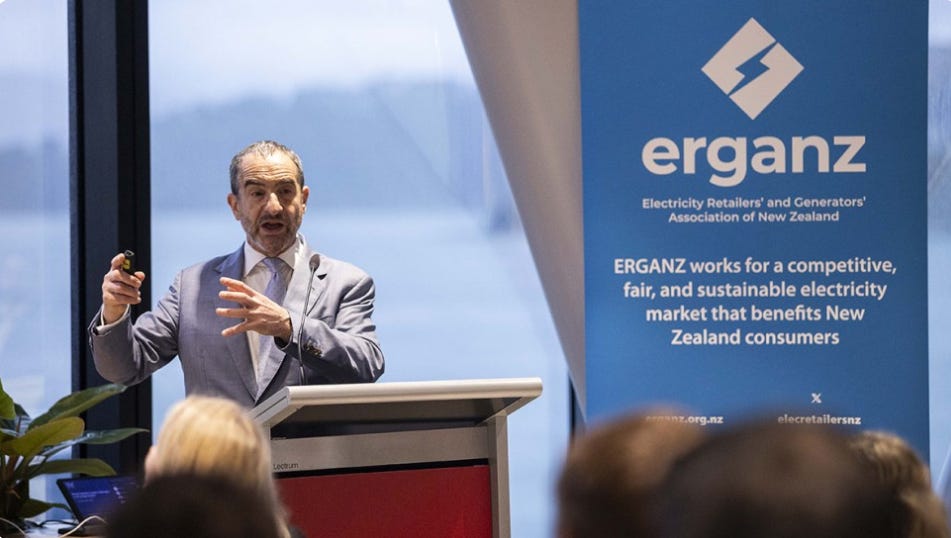
Michael Liebreich giving his presentation at erganz.
On 9 June, Michael published a Substack responding to the Australian government’s newly announced target of “35 by 35” – for electrification to lift electricity’s share of final energy to 35% by 2035. His view is that the focus on electrification is exactly right, but that final energy is the wrong set of goalposts.
Bryony Worthington published a LinkedIn article on 3 June, joining the debate over climate risk prompted by the Cleaning Up episode with Roger Pielke Jr., released the same day (see Show Snippets below).
Upcoming
Cleaning Up will be hosting a live recording with Michael in conversation with Sec. John Kerry on the first business day of London Climate Action Week, Monday 22 June. If you are interested in attending, please contact team@cleaningup.live.
The following day, on 23 June, Michael will be speaking at the Energy After Fire event organised by Constructive, Ember, Carnegie Mellon and Catalyse Europe, and supported by Cleaning Up, Global Renewables Alliance, and the Centre for Net Zero. It is described as a “practitioner-led afternoon of constructive debate”.
Bryony will also be active during Climate Week, speaking at the Octopus Energy Tech Summit on 22 June, and then taking part in an Indicators of Global Climate Change policymakers’ briefing on 24 June.
James Cameron, chair of the Cleaning Up editorial council, will be taking part in discussions about the links between climate change and sport – in his role as chairman of the Professional Cricketers’ Association. Topics will include the effect of heat on performance, the future design of stadiums, and the potential for using grounds as places where electricity is generated and stored.
Commitments for James during Climate Week include an interview with the ‘We Don’t Have Time’ podcast on 23 June, and a podcast with Arden Climate the following day.
Show Snippets: Henrik Andersen & Roger Pielke Jr.
Episode 261: Henrik Andersen
Henrik Andersen, chief executive of Vestas Wind Systems, joined Michael for the 10 June episode of Cleaning Up. He said that the direction of wind energy costs remains down, after the hiatus earlier this decade when financing costs jumped. Onshore wind in Germany was a good example, he noted, “because a year and a half ago it was at 85 [euros per megawatt-hour]. And everyone goes, oh, it’s the interest rates or is it is everyone losing money on it? No. But it is when you use the I call it ‘the Chinese principle.’ Scale up, do more volume, because that means we can construct, install something every day, every week, every month. And that means better uses of cranes, better uses of people, better logistic access. And that has driven that price from 85 to 65 [euros per MWh] without too much external changes.”
Andersen argued for maintaining a diverse energy mix, and on security of supply:
“Listen, I’m in favour of all energy sources. Because right now, the biggest challenge for Europe was we let the nuclear competence go because we stopped doing it. Today, we sit in a situation where 450 million people across Europe are importing 55% of [their] energy. That is dependency, but on somebody outside Europe.”
Episode 260: Prof. Roger Pielke Jr.
The 3 June episode saw Michael in conversation with Professor Roger Pielke Jr., senior fellow at the American Enterprise Institute and author of ‘The Honest Broker Substack’. They discussed the recent debunking as “implausible” of the most pessimistic climate scenario cited by the Intergovernmental Panel on Climate Change – RCP 8.5 – which had previously been used to justify some of the media’s more alarmist reports. “There is this theory of change that we get action on energy systems by scaring people to death over climate change or tipping points,” said Pielke. “And not only does it not work, it can actually backfire in the sense that people lose faith in science. The RCP 8.5 story is ultimately a story of self-correction in science, which is what science does really well. Yes, it took too long, and there are still people who are pushing back again.”
Pielke, however, was adamant on the reality of manmade climate change and the need for decarbonisation:
“Aggressive mitigation makes sense, because the less we poke the system, it doesn’t eliminate the risk of abrupt changes in climate, but it certainly reduces them. And again, you’re not gonna be able to put a dollar value on it. You’re not gonna be able to predict when it’s gonna happen. This is one of those things where it’s one of those benefits we get from aggressive mitigation is we’re just provoking the system a little bit less.”
News from the Network
Our Leadership Circle
Copenhagen Infrastructure Partners said on 8 June that it had agreed to sell minority stakes in a 500MW battery storage project to the Scottish National Investment Bank and the Nuclear Liabilities Fund. The two-hour Devilla installation at Kincardine is part of a 6GW portfolio of battery sites CIP is developing in Scotland and England.
Arup announced on 2 June that it had bought EnTrade, the nature restoration marketplace. It said that EnTrade “enables farmers and land managers to earn income from environmental projects and helps businesses to meet their environmental goals”. Projects include water quality, biodiversity and greenhouse gas reduction.
On 22 May, Cygnum Capital said that its African Local Currency Bond Fund had invested $11 million in a sustainability-linked bond issued by the Development Bank of Rwanda. This will help the bank expand lending to sectors such as small and medium-sized companies, energy, infrastructure and agriculture.
EDP committed on 1 June to invest EUR 1.3 billion in onshore and offshore wind, solar and battery projects in France by 2030. The 1GW of capacity will be developed and built by its French subsidiary and by Ocean Winds, its joint venture with Engie. It added that the installations would be “fully dispatchable by the grid operator”.
Octopus Energy called on the UK government on 27 May urgently to implement a lower-cost approach to the energy transition, after regulator-set system costs on electricity bills increased GBP 50 earlier this year and “are due to rise a further GBP 100 or more by 2030”. Big decisions are necessary, “tweaks are not enough,” it said.
Our Alumni
Thomas Pellerin-Carlin, French member of the European Parliament and guest on episode 255 of Cleaning Up in April 2026, made a speech to the ENVI committee on 2 June, arguing that war in the Middle East has changed the calculus for Europe on car CO2 emissions. “Europe barely produces 3% of the oil we consume, but we already produce 100% of the electricity we consume. So going for electric cars is also key for our energy security,” he said.
Teresa Ribera, the European Commission’s executive vice-president for a clean, just and competitive transition and guest on episode 37 of Cleaning Up in March 2021, told the Eurelectric Power Summit on 4 June that the Ukraine War and the Hormuz blockage had shown that fossil fuel was the most intermittent form of energy, and that electrification was essential.
See You in a Fortnight!
The next edition of the Cleaning Up newsletter will be on Monday 29 June. We would love your feedback and ideas for the Cleaning Up newsletter or for the show. Please send them to team@cleaningup.live.
 | A guest post by
|