
Issue 14: Have Renewables Shielded Us From The Iran Crisis?
A new report suggests so.



Four and a half months into the Iran conflict, with passage through the Strait of Hormuz still problematic and hostilities continuing, there is increasing attention on how electricity systems have coped with the disruption to gas supplies.
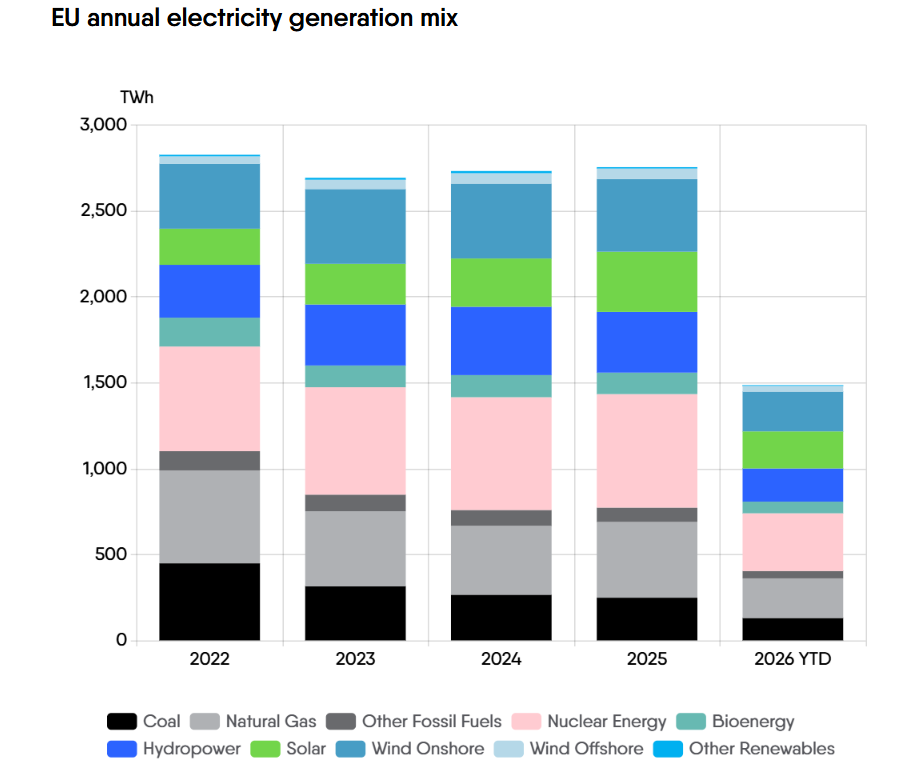
A new report by Eurelectric, one of Cleaning Up’s Leadership Circle members, concluded this month that “record clean power generation helped shield Europe from a sharp gas-price shock in early 2026”. In May, solar became the EU’s largest single source of electricity, at nearly 23%. However, it also said that higher prices outside solar hours showed the “urgent need” for more energy storage and grid development.
The Eurelectric report comes in the wake of Michael Liebreich’s warning late last month that electricity “needs to be cheap, clean, abundant and resilient” if electrification, and decarbonisation, are to command public support in Western economies. His article set out an eight-point plan to “Make Electricity Cheap Again”.
Show Snippets: Marie Cheong and Ravi Menon
The lion’s share of global energy demand happens in places other than Europe or the US, and the latest episodes of Cleaning Up have been exploring the contrasting issues in Southeast Asia and, via our special Deep Dive, in Australia.
The 8 July episode saw Michael in conversation with Marie Cheong, founding partner at 100x100, a climate tech venture builder and venture capitalist for South and Southeast Asia. She explained that her business aims to build a portfolio of companies that can abate 10% of world emissions. Each of these firms, led by an experienced entrepreneur, should have the potential to “abate 100 million tonnes of carbon dioxide equivalent and be a $100 million revenue businesses at scale”.
Cheong said: “There’s a misconception around climate that it’s all about these silver bullet technologies; it’s nuclear fusion and direct air carbon capture that’s what’s going to save us. But we can abate 50% of global carbon emissions using the technology that we have today.”
In Singapore, Marie took Michael to the People Bee Hoon noodle factory. The business teamed up with Muun AI earlier this year to collect petabytes of data and assess how the noodle manufacturing could be made more energy-efficient, for instance by identifying machines that are steaming for too long, or those with a seal leakage. The episode follows Marie and Michael inside the noodle factory, where they meet factory owner Desmond Goh and Muun AI CEO Kathryn Knight to discuss how the two of them are working together to improve operations.
For the 1 July episode, Michael talked to Ravi Menon, Singapore’s ambassador for climate action. Menon took a firm line on what’s needed to move Asia from coal to clean power: “I don’t quite agree that all we need to do is to grow the green stuff and leave the rest behind. It doesn’t work in Asia. It probably works in Europe or America, but it doesn’t work in Asia. You take the coal fleet for instance, 60-70% of Asia’s electricity comes from coal-fired power plants.” He added: “You’ve got to phase down or phase out the coal fleet. And that’s what China has been doing. It’s not just about building the renewables.”
Menon said that Singapore would be able to raise its percentage of electricity generated by solar, but there was a limit due to the country’s size, available land space, and also the amount of cloud cover during the year: “The other part of the equation is renewable energy imports. I do believe that the world needs to transit to a paradigm just as, in an earlier era, we traded goods and services for mutual prosperity and gain, we need to look at trading of green electrons.” The logic is for an ASEAN region power grid and, in the meantime, Singapore has “already started to import a small amount of electricity through the Laos-Cambodia line that goes through Malaysia”.
Deep Dive Australia
Michael sat down with Marc England, chief executive of Ausgrid, for the latest episode in Cleaning Up’s Deep Dive Australia, published today (13 July). Ausgrid is the largest distributor of electricity on the country’s east coast, supplying Sydney and its surrounds. England told Michael that at the current stage of the energy transition, electricity demand is “becoming much less predictable … while supply is becoming much less controllable. [It’s] a much more volatile system.”

England said that one of the biggest challenges in the transition is to ensure that the benefits of the expansion of solar and storage reach all consumers, with the lowest possible costs. “30 percent of our network customers don’t have a garage or a driveway,” while 40% are renters. Part of the answer lies with building out energy storage, he said: “If the power could be stored locally, it could be distributed to everyone in the community, even those in social housing or in rental apartments or those that don't have their own roof.”
The 6 July episode saw Michael in conversation with Chris Bowen, Australia’s minister for climate change and energy. Bowen commented on Australia’s modest record with electric vehicle adoption compared to some other countries. He said EVs have recently risen to take 10% of new car sales — up from 1% in 2022 — thanks to a “couple of things”: First, “it’s related to the battery story. If you’ve got solar panels and a battery now, you think, maybe our next choice should be an EV. So we don’t have to pay for energy at night. We can use it off our battery. So our EV, in effect, becomes very cheap or free.” The second factor he mentioned has been the vehicle emission standard that was introduced in 2023, “very controversial” at the time, but instrumental in raising the number of vehicle models under A$40,000 from none at the time to 10 now.
Bowen added: “I think Australians have crossed the Rubicon in many senses. Yes, there’s a fuel crisis on now, but I think Australians intuitively know these crises are going to get more common, not less common, potentially worse, not better. And so having an EV is a very sensible economic choice.”
News from Cleaning Up
Marie Cheong (see above) will be joining Cleaning Up as a guest host, doing interviews with business leaders, policy-makers and investors across South East Asia. She said she would aim to “try to give people a little bit of perspective of what the green transition, what decarbonisation looks like across the region. So very excited to share my region with your listeners.”
Cleaning Up’s Deep Dive Australia has had a particularly strong start in terms of listeners. The first episode —with Darren Miller, chief executive of the Australian Renewable Energy Agency — has had more than 20,000 views and listens since publish.
Upcoming
After a hectic programme of Cleaning Up events in Singapore and Australia in late May and early June, and then during London Climate Action Week in late June, the next meeting on the horizon is a dinner on energy and security in London in the second week of September. Cleaning Up will then be in New York from 21 September for Climate Week. For more information, please contact team@cleaningup.live.
News from the Network
Our Leadership Circle
A report from Eurelectric on 1 July said that the European TTF gas price jumped by 60% between February and March, but the EU day-ahead electricity price actually fell by 9%, against the backdrop of the beginning of the Iran War. The power price drop was “thanks to seasonal factors such as lower demand and stronger spring renewable output”.
Wärtsilä said on 30 June that commercial operations began from its 150MW and 300MWh battery storage plant provided to Revera Energy in Bungama, South Australia. It commented: “South Australia regularly operates with some of the world’s highest levels of variable renewable generation, making advanced storage infrastructure essential to maintaining energy stability and reliability.”
Actis announced on 2 July that it had agreed to buy a clean energy business in Poland from CVC DIF. Klara Renewables has a 171MW suite of operating wind plants, but has ambitions to increase that to 1.5GW including solar and battery storage. Actis said: “Poland is one of the most exciting markets for energy investment in Europe, benefitting from an open, regulated electricity market and strong institutions and regulatory frameworks.”
On 30 June, Copenhagen Infrastructure Partners stated that it had taken a final investment decision on the Cobirgy biogas project in Catalonia, Spain. Its Advanced Bioenergy Fund 1 has €727 million of capital to deploy, and Cobirgy will “process up to 500,000 tonnes of feedstock annually, converting agricultural and industrial organic waste into biomethane”, CIP said.
Our Alumni Network
Climate journalist David Wallace-Wells, guest on episode 152 of Cleaning Up in January 2024, wrote an article titled ‘We Need to Retrofit the Planet. The Heat Wave Proves It’ in the New York Times on 1 July. He developed the theme on Democracy Now, arguing that recent heatwaves in the US and Europe show that global warming is “accelerating past thresholds that we used to consider unacceptable”.
Mark Carney, prime minister of Canada and guest on episode 84 of Cleaning Up in May 2022, signed a Canada-British Columbia Cooperative Prosperity Agreement on 2 July. This commits the parties to build four new liquified natural gas plants, to “boost LNG supplies for Canadians and our allies”. The agreement also covers the expansion of the Red Chris copper mine, and a new North Coast electricity transmission line.
Bill McKibben, the climate and energy author who was the guest on episode 98 of Cleaning Up in September 2022, published an article on 7 July entitled ‘Oil as Achilles Heel’. He argued that a recent Ukrainian drone attack on Russia’s refinery in far-away Omsk showed that fossil fuel installations are now a particularly vulnerable part of an economy to enemy attack, whereas the solar and wind plants Ukraine has built are too scattered to be easily knocked out.
See You in a Fortnight
The next edition of the Cleaning Up newsletter will be on Monday 27 July. We would love your feedback and ideas for the Cleaning Up newsletter or for the show. Please send them to team@cleaningup.live.
 | A guest post by
|