


Hundreds of billions of dollars are being invested in artificial intelligence data centres, and most forecasts are for further, rapid acceleration. Two questions stand out. How big will the build-out be? And is this good – or bad – for the transition to low-carbon energy?
The likely scale of the data centre boom was the subject of combative debate between Michael Liebreich and Arshad Mansoor, president and chief executive of the EPRI, in the 12 August episode of Cleaning Up (see Show Snippets below, and chart at the end of that section).
The answer depends not just on the ambition of the so-called ‘hyperscaler’ companies, but also on other factors: the severity of any stock market correction for high-flying AI stocks, and on more down-to-earth factors such as the availability of power, grid connections and skilled labour. Not to mention the strength of local opposition, increasingly evident for instance in the US.
On the face of it, the AI boom might appear to be awkward news for wind and solar energy, in that data centres depend on an uninterruptible supply of electricity, and some sites are being built in lock-step with new gas-fired power stations.
However, batteries and grid investment can bring renewables into contention to power data centres. There are also many efforts underway to design data centres that add to the flexibility of demand in an electricity system (for instance, see Copenhagen Infrastructure Partners’ deal with Thylander below).
Then there is the question of the effect on electricity prices, and therefore on the political environment for the energy transition. It could go either way: the extra demand for power could push up wholesale prices and therefore bills; or, if there is enough generating capacity in place, it could enable network costs to be spread between more kWh of demand, improving affordability for consumers.
News from Cleaning Up
On Wednesday this week, Cleaning Up will publish the ninth and final episode of its Australia Deep Dive. The preceding eight episodes, in which Michael Liebreich spoke to luminaries of the energy and climate scene Down Under, such as Minister Chris Bowen and Ausgrid Chief Executive Marc England, have been even more popular with listeners than expected. In this week’s episode, Michael will be interviewed by Anna Freeman about the most striking conclusions he drew from his action-packed visit to Australia.
Meanwhile, Michael has continued to criticise international energy companies, forecasting institutes and governments for their persistent use of the concept of ‘primary energy’. He wrote last week: “Measuring energy usage in units of primary energy is like measuring nutrition in acres. People need food, not food waste or land inefficiently farmed. People need energy services, not thermal waste or fossil fuels inefficiently extracted.”
Bryony Worthington published an article on 19 August praising a UK government initiative to tackle aircraft contrails. She wrote: “Contrails are clouds left by condensation, and they can be avoided by adjusting an aircraft’s cruising altitude or path. Not all clouds shade the planet; contrails unfortunately contribute to warming/trapping heat in – especially at night when the planet would otherwise be doing its best to cool down.”
Upcoming
Cleaning Up will be in New York for Climate Week, and hosting a Leadership Circle Breakfast in New York on 21 September. We’ll bring together our Leadership Circle members, their guests, and other key stakeholders in the Cleaning Up network. If you’re planning to head to New York for Climate Week, please let us know by replying to this email, or by contacting team@cleaningup.live.
The issues of energy and security will be the focus in mid-September for the first of a new season of dinners for the Cleaning Up Leadership Circle. These are closed-door, smaller events that we’re excited to add to our programme line-up. The October dinner will focus on the electrification of mining.
In the second week of November, the Cleaning Up team will be hosting an event at COP31 in Antalya, Türkiye. Please get in touch (team@cleaningup.live) if you will be attending COP and would like to join us.
Show Snippets
Episode 271: James Macnaghten
In the 19 August episode of Cleaning Up, Bryony spoke to James Macnaghten, founder and chief executive of Caldera, the UK-based zero-carbon heat company. Bryony visited the factory where its heat batteries are made, combining recycled aluminium and iron ore pellets to create a long-lasting, efficient heat store. The technology is designed for industrial processes up to 200 degrees Celsius. Macnaghten said: “We take electricity in, we store it as heat, and we produce steam on demand for factories that run processes, brewing, distilling, sterilisation, pasteurisation, a whole range of processes.”
He said: “The big numbers are 25% of all energy is industrial process heat. Some of it is very high-temperature, so steel making, cement making. But of that 25%, 10 [percentage points are] below 200°C. And we go, ‘it’s really addressable’. I don’t know why everyone’s obsessing about high-temperature. They go, ‘we’ve got to tackle all these really hard problems’ and I’m like, ‘but we haven’t done the easy ones’. We shouldn’t be spending our effort on things to do 1,500°C when we haven’t done everything below 200°C.”
Episode 270: Arshad Mansoor
Arshad Mansoor, president and chief executive of the Electric Power Research Institute (EPRI), one of the world’s leading energy research organisations, sat down with Michael for the 12 August episode of Cleaning Up. Mansoor was bullish on the likely expansion of AI data centres and the resulting upswing in electricity demand internationally. He said:
“It’s real, it’s unprecedented. It’s 3x to 4x demand growth than the US has seen in the last 30, 40 years. Right now, we anticipated around 100 gigawatts of new demand. And our report that came out maybe six months ago is already obsolete.”
See chart below:
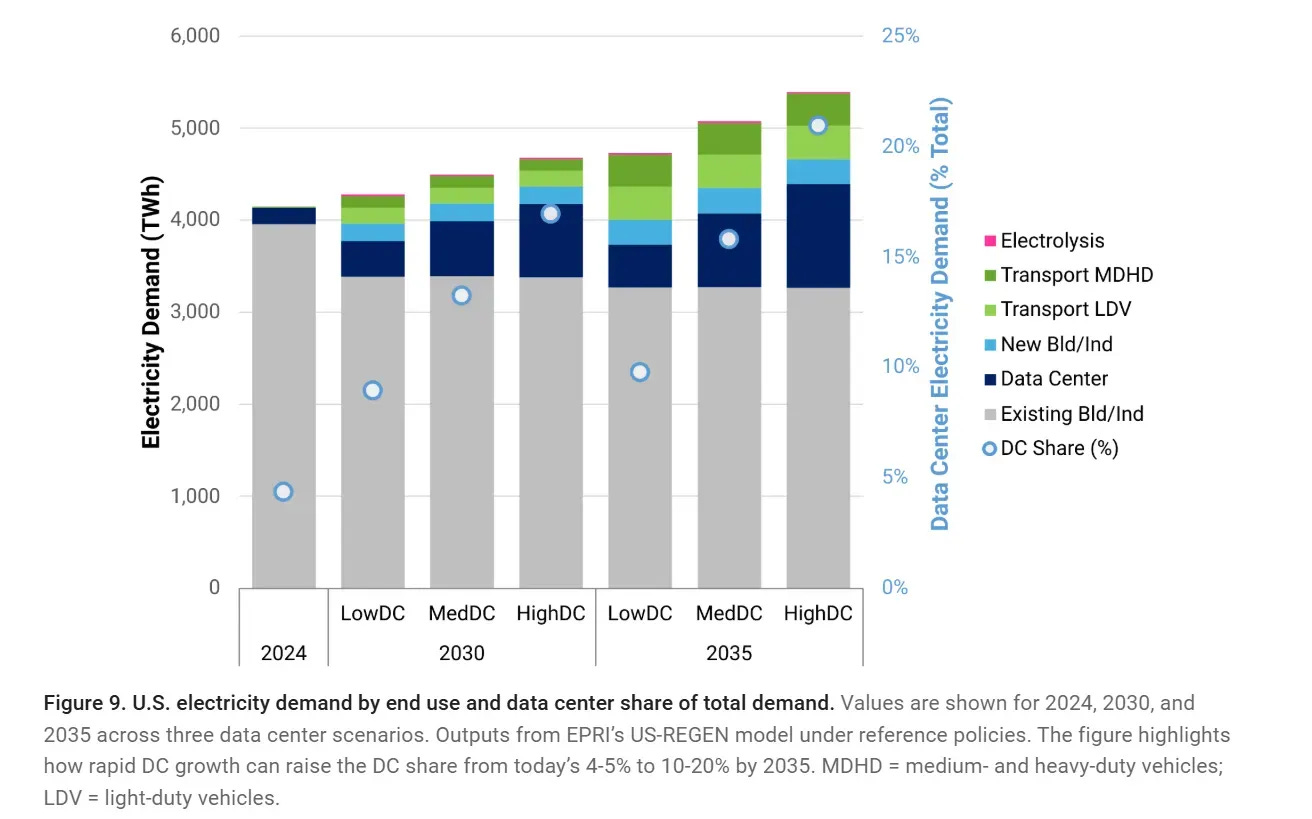
He and Michael agreed on the fact that data centres would multiply but they debated vigorously the speed of this, and therefore the energy demand implications. Michael said: “My number that I published at the end of 2024 was 30GW in the US by 2030.” Mansoor replied: “Change it!” Michael argued that there were important “constraints on the grid and then there’s a constraint on transformers and electrical equipment generators and so on. There’s a constraint on GPUs, there’s a constraint on high bandwidth memory, there’s a constraint on skills, just how many plumbers and electricians.”
Deep Dive Australia
Episode 8: Prof Martin Green AM
The 17 August episode of the Australia Deep Dive found Michael in conversation with Martin Green, Scientia professor at the School of Photovoltaics and Renewable Energy Engineering at the University of New South Wales. Green said:
“Since about 2016, the majority of panels made commercially have used technology that we developed, largely in the 1980s and 90s within our research activities. So at the moment, from 2016, over 90% of the panels that have been made commercially have our technology in them.”
They discussed two different technological approaches for PV panels in the future, one in which perovskite is deposited on top of silicon, and the other in which a pure perovskite module is stacked on top of a pure silicon one. Asked which PV technology he felt could dominate in the future, Green said: “Well, I think the combination is the best.” The advantage is that “you can have the cells connected in series so you don’t need any extra connections. You just get better power output from the same connections, essentially.” He added that his feeling is that it’s also “got to be lower-cost”.
News from our Network
Our Leadership Circle
Copenhagen Infrastructure Partners said on 14 August that it had closed its Growth Markets Fund II at around $3 billion. This fund, which is three times the size of its predecessor, will finance greenfield investments in high-growth, middle-income markets such as India, Vietnam, the Philippines, Mexico and South Africa. Early commitments have included battery storage in Chile, solar and batteries in Mexico and onshore wind in Romania.
The previous day, CIP announced that it and Danish property group Thylander had started building a data centre in Esbjerg that will work “not just as a consumer of electricity, but as an integral part of the broader energy infrastructure”. Also investing will be PensionDanmark, and the site will use energy management from Plexar to optimise electricity consumption and reduce the load on the power grid.
Octopus Energy said on 10 August that the UK had already spent GBP 1 billion this year on curtailing wind projects and switching on gas-fired plants instead. The data come from the Wasted Wind website, created by Octopus’s Robin Hawkes. The company said: “The problem comes because Britain’s electricity grid often cannot move all the power from where it is being generated to where it is needed.”
The Wall Street Journal reported on 18 August that KKR had made a $9 billion bid for US-based gas and electricity distributor UGI Corporation. The latter distributes liquified petroleum gas in Europe, as well as gas, LPG and electricity in Pennsylvania and a number of other eastern US states.
Our Alumni Network
Chris Bowen, Australia’s energy and climate minister and guest on the second episode of the Cleaning Up Deep Dive in July 2026, announced a A$14.8 billion Fuel Security and Resilience Package. The statement, on 18 August, included the creation of a government-owned strategic reserve of one billion litres of diesel and jet fuel, and an increase in mandatory industry fuel stockholding requirements by 2030.
Tom Steyer, billionaire philanthropist, former candidate for governor of California and guest on episode 81 of Cleaning Up in March 2022, told Politico in an interview published on 15 August: “The climate statistics are terrible. We are getting hotter much faster than people expected. The impacts of that heat are much greater than people expected. It is hitting Californians specifically. It’s hitting us in terms of home insurance because of fires. It’s hitting us in terms of electricity rates.”
Heart Aerospace, headed by Anders Forslund, guest on episode 194 of Cleaning Up in January 2025, announced on 13 August that the world’s largest electric aeroplane had completed its first flight. Known as X1, the plane spans 106 feet and weighs 25,000lbs. It flew for 27 minutes in upper New York State.
See You in Three Weeks!
The next edition of the Cleaning Up newsletter will be on Monday 14 September. We will return to the usual fortnightly sequence after that.
We would love your feedback and ideas for the Cleaning Up newsletter or for the show. Please send them to team@cleaningup.live.
